The Managed Descent
What the IEA's oil reduction plan reveals

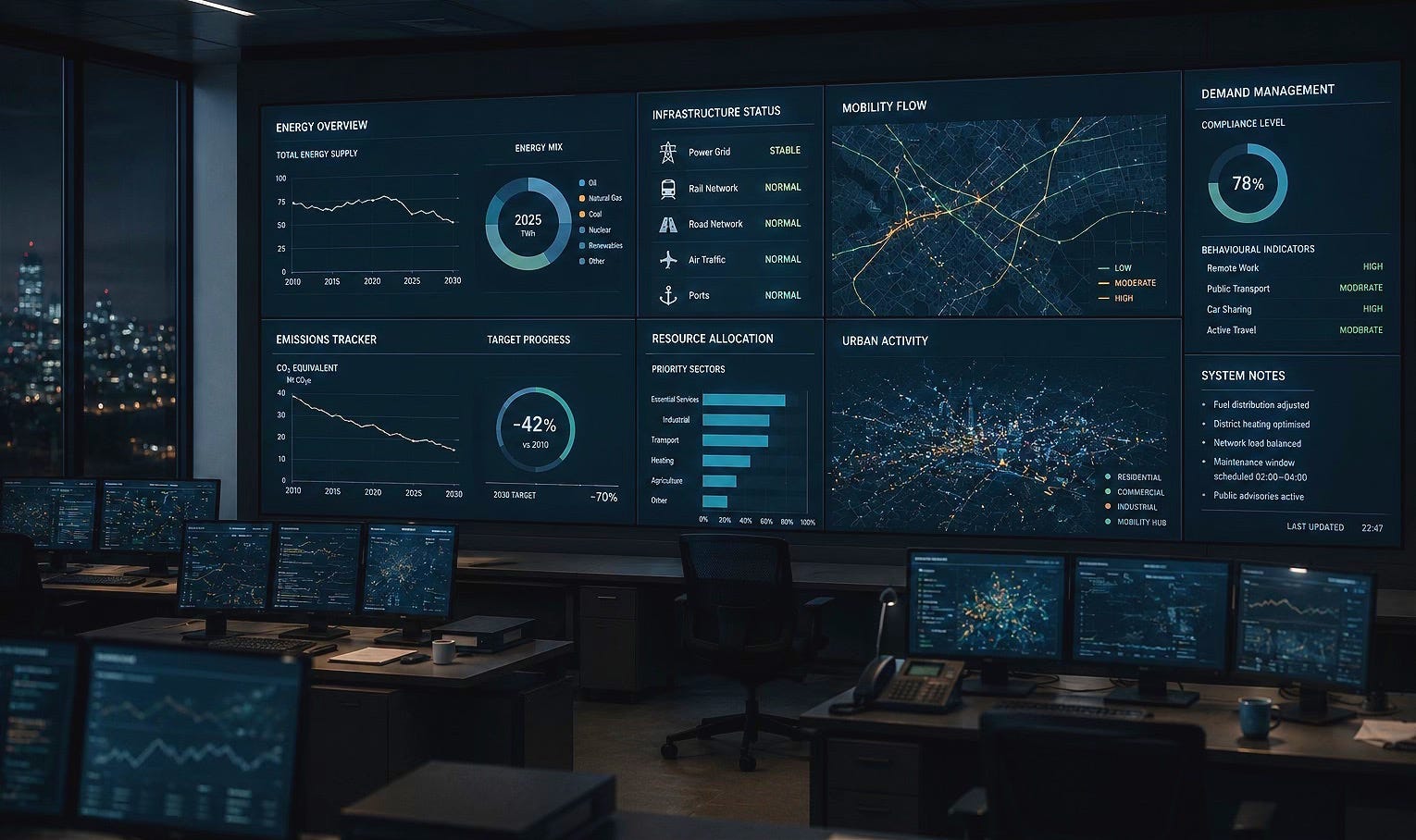
In 2022, the International Energy Agency published a ten-point plan for how to reduce oil consumption in the event of a major supply disruption. It was framed as a temporary response to crisis. Read more closely, it looks like something else entirely.
Presented as a set of temporary and pragmatic recommendations, it appears at first glance to be a conventional policy response to an acute geopolitical shock. Yet beneath its surface lies something far more significant. It is not merely a contingency plan. It is a behavioural blueprint for a world in which energy abundance can no longer be assumed.
The premise itself is revealing. A disruption of twenty percent is not framed as an unthinkable catastrophe, but as a plausible scenario requiring immediate adaptation. The February 2026 US and Israeli strikes on Iran has created exactly this scenario where 20% of global supply is disrupted for an indefinite period.
This report signals a quiet shift in institutional thinking. For decades, the dominant narrative has been one of continuity, underpinned by technological optimism and the assumption that supply constraints would be resolved through investment, substitution, or innovation. Here, however, the emphasis is not on increasing supply but on reducing demand. The burden of adjustment falls not on production, but on behaviour.
What follows in the plan is a series of measures that, taken individually, appear modest and even reasonable. Lower speed limits on highways, encouraged working from home, restrictions on car usage in urban areas, reduced reliance on air travel, and a shift toward public and shared transport all carry a veneer of practicality. Each can be justified on grounds of efficiency, cost savings, or environmental benefit. Yet when considered together, they form a coherent pattern. Mobility is curtailed. Individual autonomy in transport is reduced. Physical presence is substituted with digital interaction. Consumption is moderated not through price signals alone, but through direct intervention in daily life.
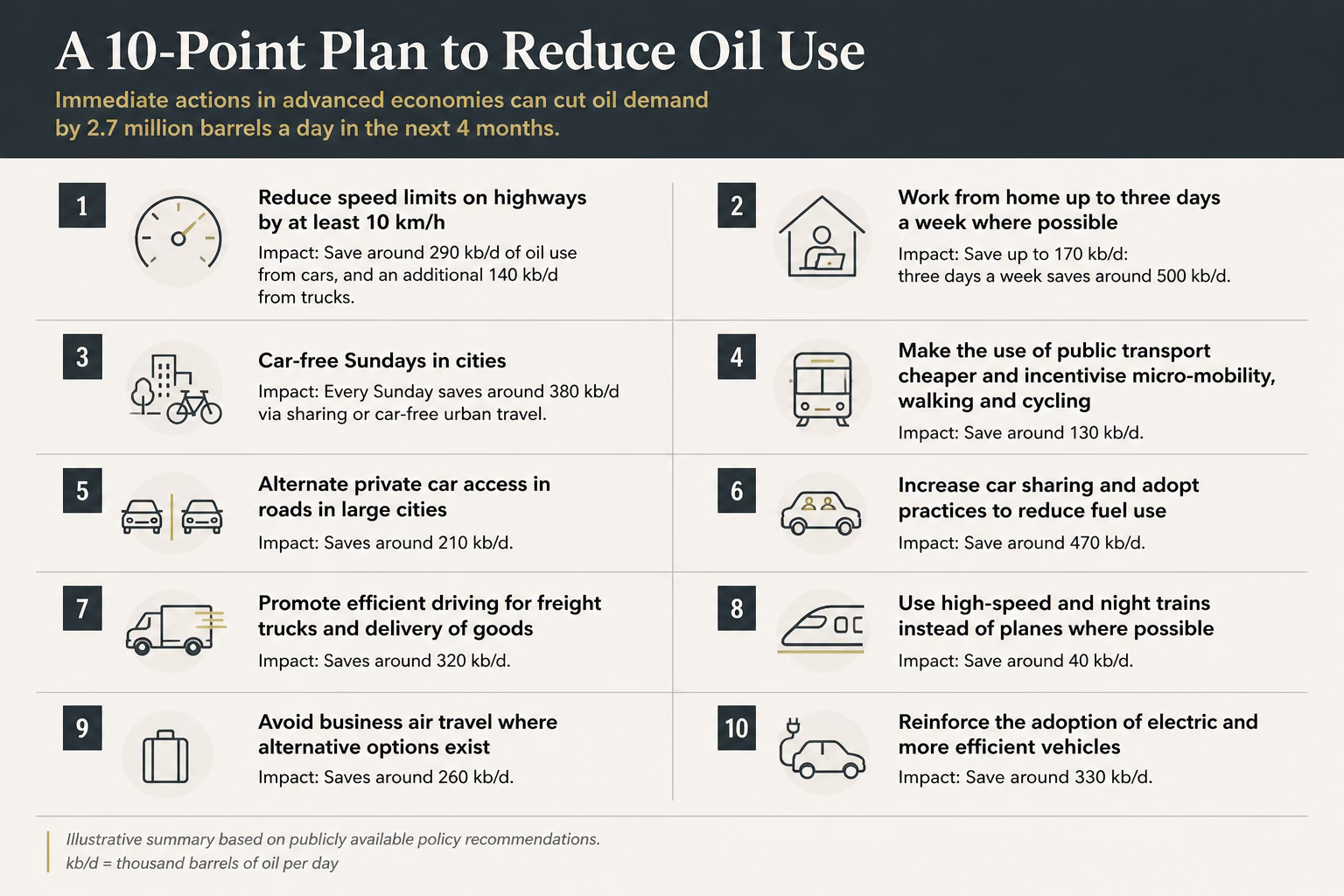
This pattern is not accidental. It reflects a fundamental constraint that cannot be easily addressed through conventional economic mechanisms. Oil is not simply another commodity that can be replaced or expanded at will. It is a uniquely dense, portable, and versatile energy source that underpins the entire architecture of modern transport and much of global industry. As the Energy Institute’s Statistical Review makes clear, oil remains the single largest contributor to global energy demand, accounting for roughly a third of total consumption, while fossil fuels as a whole still provide over four fifths of the world’s energy supply. Despite decades of investment in alternatives, the physical foundation of civilisation has not materially shifted. The system remains structurally dependent on hydrocarbons.
In this context, a sudden reduction in supply cannot be easily offset. There is no equivalent energy source that can be mobilised at scale within the required timeframe. The only immediate lever available is demand. The ten-point plan is therefore not an expression of policy preference, but of necessity. It outlines how a complex, energy-intensive society might attempt to function with less of the resource upon which it was built.
The implications extend far beyond the immediate scenario. What is presented as a temporary response to disruption begins to resemble a template for a more permanent condition. If supply constraints were to persist or deepen, whether through geological decline, underinvestment, or geopolitical fragmentation, the measures outlined would not remain optional or short-lived. They would become structural features of the system. The distinction between emergency response and long-term policy would blur, and the management of demand would move from the margins to the centre of governance.
There is an important subtlety here that must be understood if the argument is to retain its credibility. The plan does not emerge from a desire to control behaviour for its own sake. It emerges from the recognition that behaviour must change when the physical basis of the system can no longer support existing patterns of consumption. This is not ideology imposed upon reality, but reality imposing limits upon ideology. The language of sustainability, efficiency, and climate responsibility provides a framework through which these changes can be communicated and justified, but the underlying driver is more fundamental. It is the constraint imposed by finite, declining, or increasingly costly energy.
Seen in this light, the measures take on a different character. Reducing speed limits is not simply a matter of improving safety or marginal fuel efficiency. It is a way of stretching limited resources across a larger system. Encouraging remote work is not only a reflection of technological progress, but a means of reducing the energy cost of daily economic activity. Limiting air travel and promoting rail transport reflects the stark differences in energy intensity between modes of transport, and the necessity of favouring those that are less demanding. Even the promotion of electric vehicles, often framed as a solution to oil dependence, sits within this logic. Electrification shifts the form of energy consumption, but does not eliminate the underlying constraint, particularly when the generation of that electricity remains tied to fossil fuels and the infrastructure required is itself energy-intensive.
What emerges is a picture of managed descent, a gradual, structured reduction in the energy throughput of society. The aim is not to halt activity, but to reshape it in ways that are compatible with a lower energy baseline. This requires changes not only in technology and infrastructure, but in expectations. The assumption of unrestricted mobility, of constant growth in consumption, of frictionless global connectivity begins to erode. In its place comes a more constrained model, in which access is moderated, choices are shaped, and efficiency becomes a necessity rather than an aspiration.
This transition is unlikely to be smooth. Modern economies are built on the premise of expansion. As explored in my earlier posts, growth is not merely desirable but structurally embedded in financial systems that rely on increasing output to service debt and maintain stability. A reduction in energy availability therefore has consequences that extend into the monetary domain. Slower growth, or contraction, places strain on fiscal systems, corporate balance sheets, and social contracts. The temptation, and often the immediate response, is to offset these pressures through monetary expansion, increasing debt, and policy intervention.
Yet such measures do not resolve the underlying physical constraint. They redistribute or defer its effects.
The ten-point plan can be read, therefore, as an early acknowledgement of a tension that will define the coming decades. On one side lies the physical reality of energy limits, expressed through declining returns, constrained supply, and rising costs. On the other lies a financial and political system predicated on continuous growth and expanding consumption.
Bridging this gap requires more than technological substitution. It requires a reconfiguration of behaviour at scale.
At present, the mechanisms for achieving this reconfiguration remain relatively soft. Recommendations, incentives, and social norms are deployed to encourage compliance. Public messaging frames the changes in terms of collective responsibility and shared benefit. In times of acute crisis, such approaches can be effective, as populations respond to clear and immediate threats. However, as constraints become chronic rather than episodic, the limitations of voluntary adaptation may become apparent. The question then shifts from whether behaviour must change, to how such change can be maintained consistently across large and complex societies.
It is here that the broader architecture of control begins to enter the picture, not as a conspiratorial imposition, but as a logical extension of the problem. If energy must be rationed, explicitly or implicitly, and if that rationing must be coordinated across millions of actors, then systems of monitoring, measurement, and enforcement become increasingly relevant. The tools for such systems already exist in nascent form within the digital infrastructure of modern economies. Financial transactions, mobility patterns, and consumption behaviours are already recorded, analysed, and influenced through a combination of private and public platforms.
The IEA plan does not articulate this next step. It remains within the domain of policy guidance and behavioural nudging. Yet by outlining the necessity of demand reduction, it implicitly raises the question of how such reductions can be achieved in a sustained and equitable manner. The answer, when it comes, is unlikely to be found solely in appeals to voluntary restraint.
What the plan ultimately reveals is not a grand strategy, but a constraint. It shows that when faced with a significant disruption to oil supply, the immediate response is to reduce demand through changes in behaviour, rather than to rely on rapid increases in alternative supply. It shows that the margin of flexibility within the current system is narrower than often assumed.
And, more importantly, it suggests that the future, if shaped by similar constraints, will involve not the seamless replacement of one energy system with another, but the careful management of decline.
This is the quiet reality beneath the rhetoric of transition. The world is not moving from abundance to a new form of abundance. It is ultimately moving from abundance toward constraint, and seeking to do so without triggering the instability that such a shift would ordinarily produce. The ten-point plan is a small but telling glimpse of how that process might unfold. It suggests that the future will not be defined by seamless transition, but by the careful management of constraint.
This post is part of a series of essays linked to a wider macro thesis: The Long Convergence.
Yes but at the same time the clowns running the show are gearing up for something which uses quite a lot of energy, WW3. Am I missing something, like joined up thinking?