When The Giants Fell
The Decline of the World’s Supergiant Oil Fields

The oil age was not built on millions of scattered wells but on a handful of giants.
They were the beating hearts of industrial civilisation. But now, one by one, those hearts are failing, ravaged by old age and exhaustion.
The Supergiants are dying.
Of the more than 65,000 oil fields discovered worldwide, fewer than 50 qualify as super-giants; geological accidents so vast that each contained over five billion barrels of recoverable crude. These fields, most discovered in the mid 20th century, have powered the modern world.
These fields fuelled industry, enabled globalisation, supported welfare states and underwrote military dominance. For decades, they provided the cheapest, easiest and most abundant barrels humanity would ever know, with net energy returns (EROEI) of 50:1 higher.
Super-giants are not just big. They are disproportionate. Roughly 70% of all conventional oil ever produced has come from giant and super-giant fields. Our civilisation was not built on marginal shale formations or scattered patches of offshore rigs. It was built on a foundation of a few dozen reservoirs in Saudi Arabia, Kuwait, Mexico, Russia, and the North Sea.
This skew is an open secret: lose the giants, and you lose the oil age itself.
Every field, no matter how vast, follows the same physics. Pressure is tapped, output rises, then plateaus, and eventually declines. Enhanced recovery such as water flooding, gas injection, horizontal drilling, they can delay the inevitable, but it cannot change the outcome. The best oil flows first. The decline is not an accident of politics or investment cycles. It is geological destiny.
When a super-giant tips into decline, the loss is monumental. A single percentage point drop in Ghawar’s output erases the equivalent of dozens of new shale wells. Unlike small fields, there is no replacing them at scale.
Ghawar (Saudi Arabia): Discovered in 1948, Ghawar has produced more than 85 billion barrels, about 7% of all the oil humanity has ever extracted (and burned). For decades it was assumed to pump over 5 million barrels per day indefinitely. But Aramco’s 2019 IPO disclosures revealed the truth: production had slipped to 3.8 Mbpd, with water cuts rising. The king of fields is quietly in decline
Cantarell (Mexico): Once the jewel of Mexico’s output, Cantarell peaked in 2004 at 2.1 Mbpd. Within fifteen years, production had collapsed below 0.4 MBpd. No amount of nitrogen injection could reverse the fall.
Burgan (Kuwait): The world’s second-largest field, discovered in 1938, peaked in the 1970s. Today it delivers around 1.6 Mbpd, down a third from its peak.
Prudhoe Bay (Alaska): Discovered in 1968, it peaked at 1.5 Mbpd in 1988. Today it ekes out barely 0.2 Mbpd.
Samotlor (Russia): At its peak in 1980 it produced 3.2 Mbpd. Now it hovers between 0.5–0.7.
The story is consistent across the board: discovery in the mid-20th century, plateau in the late 20th, decline in the early 21st. Technology bought time. But it also steepened the slope.
The following table shows the top 10 conventional oil fields and their status.
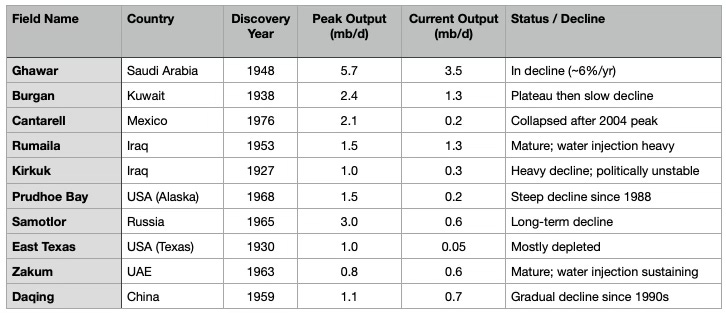
The giants reveal the future of conventional oil. Discovery period peaked in the 1960s. Plateau arrived decades later. Decline is now irreversible. The same curve describes not just individual fields but the global primary energy system.
A 2009 review (now 17 years old) of 331 giant fields found 79% already in decline. Without continuous investment, decline rates average 6% per year, equivalent to losing an entire Saudi Arabia every 3–4 years just to stay flat. The IEA’s World Energy Outlook quietly acknowledges this, even as public messaging focuses on “transition”.
Technology is usually turned to as our saviour, but it does not repeal the curve. It only accelerates the reckoning. Horizontal drilling, deepwater rigs and nitrogen injection all extract faster, extend plateaus, and then steepen collapse. The treadmill speeds up, running faster to prevent going backward.
Shale has bought the industry time, but the output delivered is low net energy return, quick to decline. It does not replace the strength and of the supergiants. Nothing can.
Why the decline of the super-giants matters is not simply a question of volume, but of scale, quality, and stability. These fields were never just large contributors to global supply; they were structurally dominant. Losing a million barrels per day from a super-giant is not equivalent to drilling a few hundred additional shale wells. The replacement burden is exponential. What the giants delivered effortlessly for decades must now be recreated through thousands of smaller, shorter-lived projects, each with higher costs, faster decline, and diminishing returns.
Just as important is the quality of the energy they provided. The great fields of the twentieth century delivered extraordinary energy returns, often fifty to one or higher. Shale, tar sands, and other unconventional sources struggle to reach five to one. The barrels may look similar on paper, but they are not equivalent in what they can sustain. Equal barrels are not equal energy. A system built on high-return fuel cannot simply swap it for low-return substitutes without consequence. This distinction is central to understanding why abundance can persist in headline numbers even as the underlying surplus that supports civilisation erodes.
The giants also provided something modern substitutes cannot: stability. Their output was steady, predictable, and long-lived, forming the backbone of industrial planning, trade, and geopolitics for generations. Unconventional wells behave very differently. They decline rapidly, demand constant reinvestment, and turn energy production into a perpetual race against depletion. The system shifts from managing abundance to managing attrition. Stability, once taken for granted, becomes elusive.
Finally, the decline of the giants reshapes power itself. Control over a handful of vast, reliable fields defined global influence throughout the twentieth century. As those fields fade, leverage disperses. Power shifts away from geology toward finance, narratives, and coordination. The language of “transition” fills the gap left by declining physical dominance, offering a story of progress where once there was surplus. But beneath that story lies a simpler reality: the foundations that once made control effortless are no longer there.
The narrative around energy transition soothe. They suggest a choice. But they hide the truth that the very foundations of the oil age are eroding beneath our feet. The giants were the steady, unseen engines that made growth look effortless. Their decline is the quiet undertow beneath the headlines
The blueprint is inevitable: discovery, plateau, decline. What happened to Ghawar, Cantarell, and Burgan will happen to the primary energy system as a whole. The age of giants is ending, and with it, the conditions that accelerated the modern world have changed. The super-giants that carried civilisation through the 20th century are slipping away. What replaces them are smaller, more fragile fields that cannot deliver the same stable flow.
Despite headlines of an oil glut (pre-war with Iran at least), the energetic base of global oil supply is eroding quietly, inevitably, and permanently.
In 2025 global output was higher than an at any time in history, but while gross energy may be in surplus, net energy is declining. And with it the foundations of society, finance and politics are changing.
The fall of the giants marks the end of the era in which abundance could be taken for granted. What replaces it is not immediate scarcity, but increasing effort, rising costs, and growing dependence on financial and technological scaffolding to preserve normality.
There is no announcement of this changing energy dynamic, but rather the system absorbs it and reflects it back as higher costs, higher debt, more strain, less slack.
By the time it becomes visible to everyone, it has already been underway for years.
This post is part of a series of essays linked to a wider macro thesis: The Long Convergence.
Flashback to “Twilight in the Desert”! Given this physical reality, it is amazing how the global hydrocarbon industry has been able to grow production through innovation. But as you point out, the lower EROEI of sources like shale gas significant economic implications.
False/ temporary wars in Ukraine and Iran ensure that the mib dies not become aware of this situation and panic... they are told by bbccnn that raging inflation ..and ultimately hard rationing are temporary...once the wars end all returns to normal.
The wars will end ...when civilization collapses